The existence of the Sumerian civilization is compelling evidence that something extraordinary happened in our ancient past. It is evidence that an advanced race inhabited our planet thousands of years ago. Conventional archaeology suggests that civilization emerged suddenly in the Middle East region and is unable to explain its origins. Scholars consider Sumer the cradle of civilization; it is the oldest civilization known in the world. However, it is unknown when the first settlers arrived. Where did they come from, or to what culture did the people who settled in the area belong? The earliest stages of Sumer’s history were determined by scholars based on archaeological and geological records. Most of the available historical data from the time was dismissed as mythology or epic poetry.
The Sumerian Empire was in the southernmost part of Mesopotamia, between the Tigris and Euphrates rivers. Currently, it corresponds to southern Iraq, from Baghdad to the Persian Gulf. It is interesting to note that according to the Bible, Eden was the place where the first man and the first woman originated. This narrative is similar to the archaeological description of Sumer. The cradle of civilization in Iraq was located in the same area between the Tigris and the Euphrates rivers.
According to conventional archaeology, the first inhabitants of Sumer were people of unknown origin, known as the Ubaidians. The Ubaid period corresponds to the prehistoric era in the history of Mesopotamia. It dates from around 6500 to 3800 BCE, but this settlement was probably established earlier than scholars estimated. The name originates from a region known as Tell al-Ubaid in Iraq. Scholars have proposed that during the Ubaid culture, an elite class of rulers arose. The families in the Sumerian civilization inherited the right to continue administering temples and granaries, as well as the responsibility of maintaining social order. Initially, it was a hunter-gatherer society, but it underwent a sudden transition to an agrarian culture before 5000 BCE.
The Ubaid people were the first agents of civilization to bring technology and scientific knowledge to the region. It encompasses medicine, mathematics, agriculture, astronomy, architecture, cuneiform writing, education, law, religion, philosophy, art, and music. Ubaidians are considered the creators of the civilization we enjoy today. Beginning with the introduction of agriculture and livestock. The development of skills such as weaving textiles, carpentry, pottery, and beer production, among many other innovations. Figure of a woman nursing a child in Ur, Iraq. It was dated to 4000 BCE. The dolichocephalic skull can be seen in this statuette. (Omar Shukir Muhammed, Amir FRCP CC BY-SA 4.0).
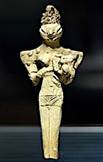
The Sumerian civilization introduced technology to drain marshes for agricultural purposes. They facilitated the use of sailing ships, promoted trade, and established industries, including textiles, leatherwork, metalwork, and masonry. Also, the advanced knowledge and innovations necessary to develop a society based on governance, architecture, language, and laws were implemented. The inhabitants of the Ubaid period were pioneers in developing and inventing various innovations for the first time in human history, including wheeled vehicles, cereal cultivation, the cuneiform writing system, codes of law, philosophy, religion, and the concept of the city-state. The towns and cities of the Sumerian civilization developed around the agricultural communities of the Ubaid period. It is considered that the city of Eridu, located on the coast of the Persian Gulf, was the first city and civilization in the world, followed by ancient Egypt and the Indus Valley.
The Sumerian civilization may have emerged thousands of years earlier than scientists believe. The change from a hunter-gatherer civilization to a sedentary civilization required more than scientists realize. It wasn’t just because people started eating meat or because cognitive abilities suddenly changed. “When the Anunnaki Gods Seized the Earth” offers a comprehensive analysis of the Sumerian civilization, encompassing all aspects related to our ancient past. The results of nine years of studying the Mesopotamian texts are presented in this collection. It’s our ancient history, dating back to antediluvian times.
Enjoyable and easy-to-understand style, featuring a detailed and vivid account that will make you feel as though you’re right there at the scene. The wealth of information will surprise you. Available on Amazon Kindle in two formats, eBook and paperback. Get it now by clicking the links. Please refer to: https://ryannemaxinemeyersohn.com/. For editorial and customer reviews of my work, please refer to Readers’ Favorite.