Baalbek is a very ancient city, situated near Mount Hermon. Its history stretches back at least 11,000 years. The ancient city of Baalbek and its temple complex are among the most significant archaeological mysteries of all time. It represents the most compelling evidence of an advanced civilization on Earth in the past. Baalbek was a significant religious center in ancient times. The name likely refers to the Phoenician and Canaanite god Baal, who was worshiped thousands of years ago.
Mount Hermon was also considered a sacred place by various groups and has many temples and shrines on its slopes. Also, including those with possible connections to Baal worship. The city’s name is linked to the Phoenician god Baal. It was also known as Heliopolis during the Hellenistic period. Mount Hermon is a group of mountains that form part of the Anti-Lebanon range. It encompasses the mountain range that borders the Lebanese-Syrian border. The summit is 2,814 m (9,232 ft) above sea level. The complex is situated at the foot of the southwestern slope bordering Lebanon, east of the Litani River in the Bekaa Valley of Lebanon. The altitude is 1,170 meters (3,838 feet). The Igigi, or Nephilim, fled to Mount Hermon after their rebellion against the leaders over the grueling work in the mines.
The foundation
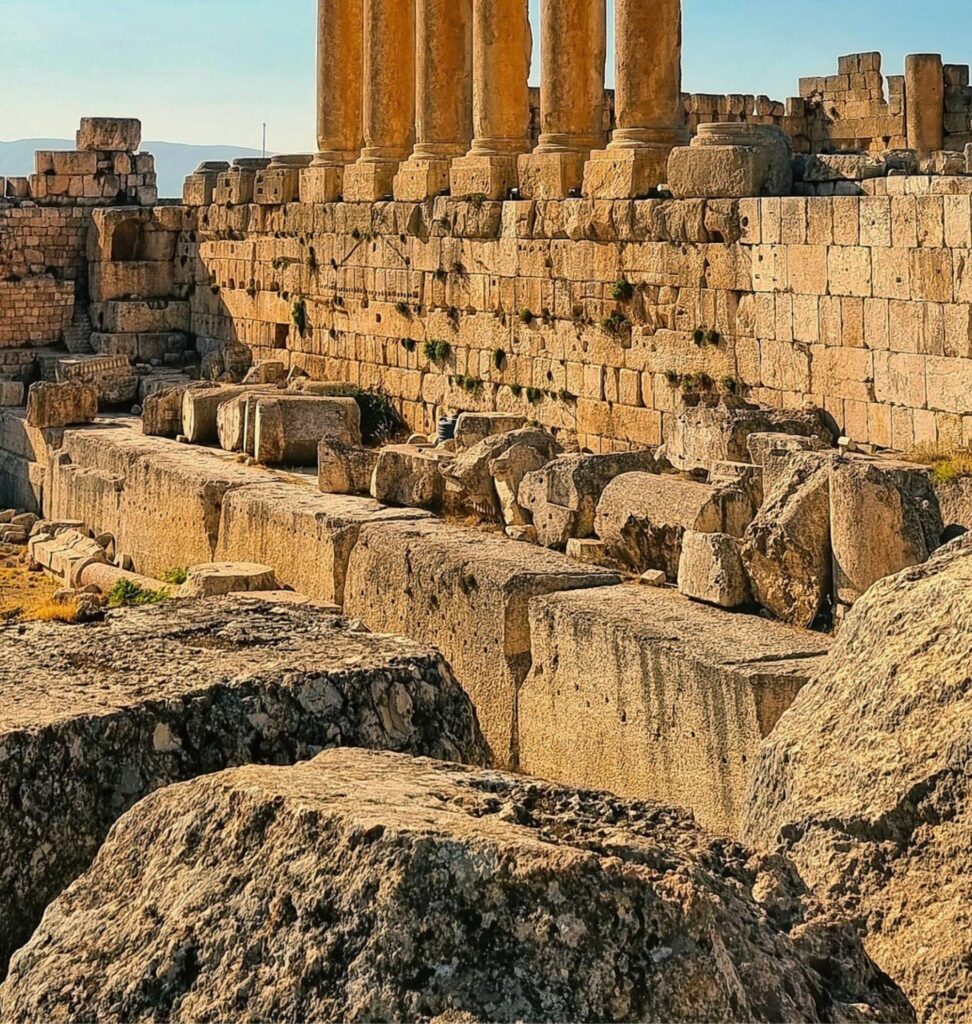
The foundation of the Baalbek complex weighs approximately five billion tons. It is composed of enormous stone blocks, known as trilithons. Please take a look at the photo below. It is a gigantic platform, perhaps a landing place. Some of the stones weigh approximately 800-1,600 tons, with the largest weighing 1,650 tons. Experts cannot explain why they used this size of stone. The engineering skills in construction cannot be reproduced even with the knowledge reached in our current 21st century. The megalithic monuments are an irrefutable testament to an ancient past in which an advanced civilization ruled our world. Scholars believe that the ancients employed human power and primitive tools, including ropes and wooden rollers, to move the stone blocks. Is this possible? What do you think? The photo shows the trilith structures at the bottom of the platform, which may have served as a landing pad.