An analysis of Mesopotamian texts reveals that the Anunnaki gods had to travel to Earth in search of specific materials to address the consequences of climate change affecting their planet, Nibiru. The king of Nibiru was named Anu. He had three sons: Enlil, the firstborn, followed by Enki and his daughter Ninmah. Anu sent his three sons on a mission to planet Earth. They settled there for thousands of years. They needed to obtain gold and precious metals that were abundant on Earth. Anu visited Earth on several occasions but always remained on his throne on Nibiru.
Enki was a scientist and very skilled in all areas of science. He was second in command on the mission, but he always managed to get things done, even against his father’s wishes. The prominent Assyriologist, Samuel N. Kramer, described him as a cunning god. Enki means “Lord of the Earth” and was characterized as the lord of the Abzu (Apsu in Akkadian), a term that refers to fresh water or underground water found within the Earth; Ab in Abzu means water. Enki was the god of water in the Sumerian pantheon and a connoisseur of all sciences and the arts of creation. In the Akkadian-Babylonian religion, he was called Ea; e-a is the Sumerian abbreviation for “Lord of Water.” The texts emphasize that Enki was the custodian of the water of life. Only a select few could drink it, and this prolonged their lives.
Scholars identified him as Ia in the Canaanite religion. Ea was described in Sumerian literature as the god of beneficence and wisdom. The story tells that he instructed mankind in writing, the arts, and all the sciences. Ea / Enki was considered in ancient times to be the master shaper of the world, the creator and protector of humanity. Enki was revered as a healer and a friend of humankind, bringing humans the arts, sciences, and civilization. It is also said that he was the creator of the first law book. At a turning point in history, during an assembly of Anunnaki leaders convened to resolve the problems they encountered during their mission to Earth, Enki suggested creating a primitive being that would alleviate them of the burden of the hard work they were doing.
“6. I will bring into being Lullu, whose name shall be “man” 8. On whom the toil of the gods will be laid that they may rest.” Excerpt from Babylonian Epic of Creation by W.G. Lambert, Tablet VI.
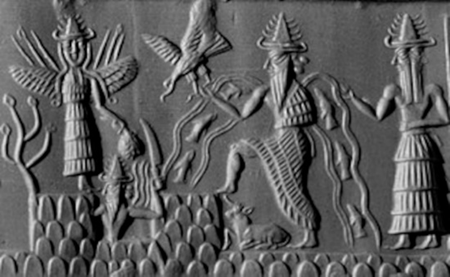
Enki built his abode “in the depths of the Abzu (South Africa).” His temple’s name was E-apsu, “house of the watery deep.” In Hittite culture, the name Ea comes from the term * hyy (life), referring to Enki’s waters as life-giving and “He whose house is water.” The Greeks called him Poseidon, and the Romans Neptune. The illustration in the relief carving depicts Enki at the center, with jets of water emanating from his shoulders to the ground.
“When the Anunnaki Gods Seized the Earth” offers a comprehensive analysis of this topic, encompassing all aspects related to our ancient past. It is a descriptive, detailed, engaging, and easy-to-understand book, featuring a detailed and vivid account. You will feel as though you are participating in the actual scene, and will be surprised by the wealth of information. Get it now by clicking the links. For additional information, please refer to: https://ryannemaxinemeyersohn.com/