Archaic Homo sapiens belongs to a period that is difficult for archaeologists to unravel. The classification of archaic human species during the Middle Pleistocene is a topic of controversy among scholars. Due to the high morphological variability in fossil characteristics, this period has been referred to by archaeologists as “the confusion in the middle.” As the age of the fossils increases, their anatomy becomes highly variable, with features reminiscent of both the earlier H. erectus and H. heidelbergensis, as well as modern humans. Archaeologists have typically characterized and classified it as H. heidelbergensis, archaic H. sapiens, or simply Middle Pleistocene Homo.
The period 300,000 years ago is important for definitively defining how Homo sapiens evolved. There is controversy among archaeologists because the methods used to classify fossils are unclear. The reason is that the quantity of fossils they have found is not sufficient to categorize the characteristics of each species. They often identify them with a species only to later discover that the classification was incorrect. It was this year that the Anunnaki conducted the genetic engineering experiments to create Primitive Man. Experts believe that the archaic Homo sapiens disappeared and then inexplicably emerged 100,000 years ago. In our research, we found the explanation for what may have happened. According to our analysis of Mesopotamian texts, it was during this period that archaic H. sapiens originated. The chronology determined during our research indicates that archaic Homo sapiens originated in 298,960 BCE, while civilized man emerged around 110,000 BCE.
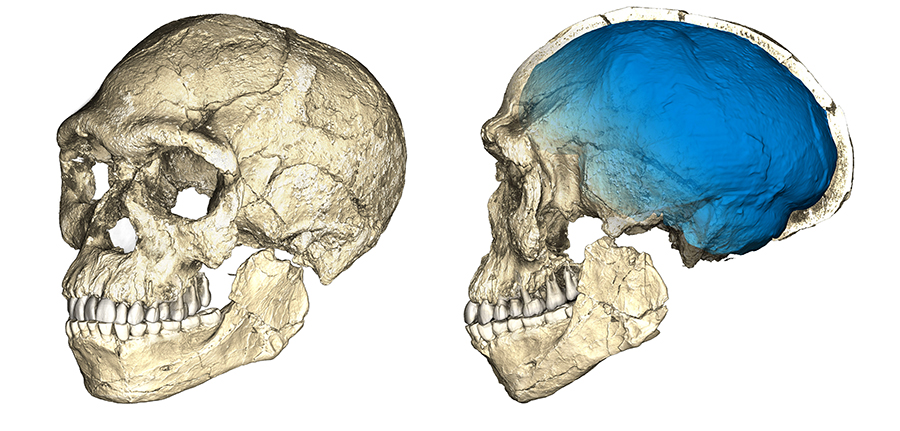
The fossils of archaic Homo sapiens were discovered in Morocco around 300,000 years ago in a cave on Mount Djebel Irhoud and are remarkably similar to those of modern humans. According to Jean-Jacques Hublin, paleoanthropologist at the Max Planck Institute, Leiden University, and the University of Leipzig, Germany, “The ancestors from Djebel Irhoud would hardly be noticed in a crowd today with a hat on.” The archaic Homo sapiens) had a modern-looking face that falls within the range of variation among humans living today. Scholars believe that the brains of archaic Homo sapiens were the same size as those of modern humans.
The difference was in the shape of the back of the head. The Djebel Irhoud had a less round, slightly elongated skull and a smaller cerebellum. The shape of the braincase in the Jebel Irhud skull resembles that of a Neanderthal. Most of the human population in ancient times was characterized by dolichocephalic skulls. The reasons for this are discussed extensively in the book. Scientists believe that the brain of Homo sapiens has evolved gradually, becoming increasingly structured and organized over time. Jebel Irhud-Photo by Philipp Gunz, MPI EVA Leipzig (License: CC-BY-SA 2.0).
Researchers believe that Homo sapiens originated from a group called either H. heidelbergensis or H. rhodesiensis. The emergence of Homo sapiens is unknown because the fossil record is scarce. The chronological age of many key specimens remains uncertain. Hence, it is unclear whether the present-day humans emerged approximately 200,000 years ago from earlier Homo sapiens or evolved gradually over the last 400,000 years.
In Shaoguan City, China, local farmers in a cave near the village of Maba made an unusual discovery in 1958. They were fossilized bone fragments with a somewhat human appearance, later determined to belong to a skull. Experts have been unable to determine to which Homo species this skull belongs. It was not possible to identify which hominid species the fragment belongs to. The only thing researchers know for sure is that it dates to the late Middle Pleistocene, approximately 300,000 years ago. It was initially determined to belong to a Neanderthal. But they re-evaluated it and found contradictory characteristics that are difficult to ignore. The fossil, known as Maba 1, exhibits a Neanderthal-like face, but its neurocranium displays affinities with many hominid taxa. The data were recently published in the American Journal of Biological Anthropology.
The Maba skull, found in China, does not fit neatly into any known human species, but it exhibits traits of both Homo erectus and Homo sapiens. Initially described as a potential Neanderthal, later analysis suggests it may be more similar to other archaic hominin specimens. Some consider it an archaic Homo sapiens or a Homo Heidelbergensis. Interestingly, the researchers concluded that Maba 1 most closely resembles LH18 found in Tanzania, which is believed to be an early Homo sapiens. It also bears similarities to the Djebel Irhoud skulls from Morocco.
This particular fossil was initially assumed to be that of Neanderthals. It is now believed to belong to some of the earliest known Homo sapiens. Currently, Maba 1 cannot be definitively classified within any hominin taxon. The researchers re-evaluated the skull and found similarities to Homo erectus, Neanderthals, and Homo sapiens. However, it does not fit definitively into any of these species and bears a strong resemblance to hominid specimens that have not been definitively classified.
The book series “When the Anunnaki Gods Seized the Earth” offers a comprehensive analysis of this topic, encompassing all aspects related to our ancient past. The results of nine years of studying the Mesopotamian texts are presented in this collection. It’s our ancient history, dating back to antediluvian times. Enjoyable and easy-to-understand style, featuring a detailed and vivid account that will make you feel as though you’re right there at the scene. You will be surprised by the wealth of information, don’t miss it. Available on Amazon Kindle in two formats, eBook and paperback. Get it now by clicking the links. Please refer to: https://ryannemaxinemeyersohn.com/. For editorial and customer reviews of my work, please refer to Readers’ Favorite.