Mesopotamian texts report the arrival of the Anunnaki gods on Earth. They are said to have come from the sky. The text Enuma Elish relates that the sky refers to the outer reaches of the solar system. Anu was the king of Nibiru, and his children were Enlil, Enki, and Ninmah. The three were sent to Earth to organize and carry out the mission. Enlil was the commander, followed by Enki. Ninmah was noted for her expertise in genetics and obstetrics, and she had a team of nurses. The Anunnaki settled on Earth for thousands of years, marrying among their kind and having children. Enlil married Ninlil, one of the nurses. They had a son named Nannar, Nergal, and Ashur. Enlil had another son with Ninmah, named Ninurta. Nannar’s children were Inanna and Utu (Shamash).
Enki married Damkina, and they had Marduk (also known as Ra). Enki had other children with concubines, one of whom was Ereshkigal (Enlil’s granddaughter), and with her he had Ningishzida. Among the leaders, seven of them formed a jury that judged and made decisions about daily life. This jury was composed of Anu, Enlil, Enki, Ninmah, Nannar, Inanna, and Marduk. This group constitutes the pantheon of gods that represented the religious beliefs of ancient times. Their names varied depending on the culture and language of each city. In addition, other important gods, who were 12 in total, were Ninurta, Ashur, Utu (Shamash), Nabu, and Nergal. Marduk married the granddaughter of Enoch, known as Sarpanit, a human, so his children were demigods: Osiris, Seth, Isis, Nephthys, and Nabu.
Physical appearance
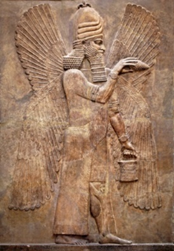
The physical appearance of the Anunnaki gods was characterized by elongated skulls, a phenomenon depicted in artistic representations from Mesopotamia, Egypt, and Mesoamerican cultures, as well as in statues and pictograms. The leaders of these civilizations, including their gods (such as the Anunnaki), pharaohs, and demigods, were often depicted in artistic expressions of the time as individuals with large heads (dolichocephalic). See the photo included. They wore sizable conical hats, highlighting their large skulls, which indicated that it was a common and typical trait among a particular group of people of the time. This feature was not only reflected in the art of the time, but countless skulls displaying it have also been found in archaeological digs worldwide. In archaeological excavations in southern Iraq, a particular type of statue was discovered, attributed to the Sumerians. See the Sumerian civilization post.
The series, “When the Anunnaki Gods Seized the Earth,” offers a comprehensive analysis of the period when the Anunnaki came to Earth, from their arrival in 442,960 BCE to their departure in 2190 BCE. All aspects related to our ancient past, the development of civilization, and up to the modern day. The results of nine years of studying the Mesopotamian texts are presented in this collection. It’s our ancient history, dating back to antediluvian times. Enjoyable and easy-to-understand style, featuring a detailed and vivid account that will make you feel as though you’re right there at the scene. The wealth of information will surprise you. Available on Amazon Kindle in two formats, eBook and paperback. Get it now by clicking the links. Please refer to: https://ryannemaxinemeyersohn.com/. For editorial and customer reviews of my work, please refer to Readers’ Favorite.